Baloo & the Pond › The Physics Behind Part One
So you want to know what the stone is.
Pick it up. It is solid. It is cool. It is there.
And almost all of it is empty.
The atom is mostly nothing
Everything you can touch — the stone, the water, your own hand — is made of atoms. An atom has a tiny dense center called the nucleus, and around it a thin cloud of even tinier things called electrons.
Here is the part that should stop you.
Imagine you grew the nucleus of a single atom until it was the size of a marble. You are holding a marble in your hand. Now the nearest electron — the one whirling around it — is a full city block away. And between the marble and the electron, there is nothing. No stuff. No filler. Just empty space.
That is what atoms are like. That is what you are made of.
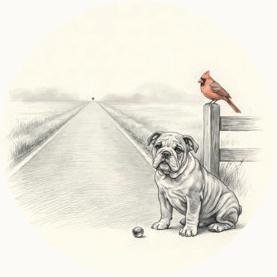
So why doesn’t your hand pass through the stone?
If almost all of an atom is empty, and the stone is made of atoms, and your hand is made of atoms — why can’t your hand go straight through?
Two reasons. The first is simple: the electrons in your hand and the electrons in the stone are both negatively charged, and like charges push each other away. That is called electrostatic repulsion, and you already know it if you have ever pushed the same poles of two magnets together and felt them refuse.
But the second reason is stranger, and it is the real answer.
There is a rule in the universe that says: no two electrons may ever be in exactly the same state at exactly the same place. Physicists call this the Pauli exclusion principle, after Wolfgang Pauli, who wrote it down in 1925. It sounds like a small technical rule. It is not. It is one of the deepest laws we have found. When you press your hand against the stone, you are trying to force electrons closer together. The Pauli principle forbids it. Squeeze harder, and the electrons cannot simply pile up on top of each other — the rule will not let them. That refusal is what makes the stone feel solid.
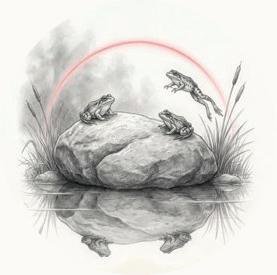
Solidity is not fullness. It is a rule, kept so faithfully that we mistake it for substance.
Why the stone is still a stone tomorrow
Here is a question no one thinks to ask.
You leave the stone on the porch. You come back the next morning. It is still there. Same shape. Same weight. Same stone.
Why?
The electrons are still whirling. The nucleus is still tiny. Nothing has visited to hold the atom together. And yet the atom did not fall apart in the night. It did not shrink. It did not blow away. The old picture of the atom was wrong about this. If you imagined electrons as little planets orbiting a nuclear sun, they should long ago have spiraled down into the nucleus and vanished, the way a satellite whose orbit decays eventually falls to Earth. But they don’t. They never do. The reason they don’t is another quantum rule: an electron in an atom cannot have just any energy. It can only have certain fixed amounts, like the rungs of a ladder. There is a lowest rung, and once an electron is on it, there is nowhere lower to go. It cannot spiral in, because “lower than the lowest rung” is not a place the universe permits.
That is why matter lasts. Not because nothing is happening, but because the rules are so strict that everything keeps doing exactly what it did yesterday. Persistence — the reeds by the pond, the leaning oak, the stone on the porch, you — is not the boring absence of physics. It is physics working so precisely that we mistake it for silence.
Nothing is ever destroyed
In the fable, there is a moment when a tadpole floats motionless in the pond, and Frog says: “It was a tadpole. Now it is the pond again.”
That is not a poetic idea. It is a physical law.
The atoms that made the tadpole are not gone. They have been taken apart and loaned onward — to the water, to the reeds, to whatever eats the reeds. Every atom that ever was is still here. They are only wearing different addresses. This is called conservation. Across the whole universe, matter and energy together are never created and never destroyed. Only moved. Only rearranged.
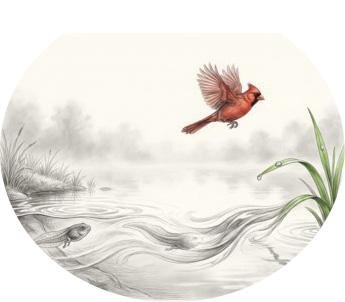
The pond has been keeping that account since long before the puppy.
The one question physics cannot answer
We have covered a great deal in a few pages. Why the stone is solid (a rule). Why the stone lasts (another rule). Why the tadpole becomes the pond (conservation). These are all real answers, and they are settled — checked in laboratories a thousand times over.
But there is one word in Frog’s lesson that no equation touches.
Present.
Physics can tell you, exactly, how the world persists. It cannot tell you why there is a now — why, out of the whole long shape of time that you will meet in Part Three, there is this one lit moment you are reading in, right now, with the book in your hand.
That there is a present, and you are inside it, is either the most ordinary fact there is or the deepest mystery we have. Frog, master of the still moment, chose the second.
In the end, so does the physicist.
Turn the page, and we will spin a coin.