Baloo & the Pond › The Physics Behind Part Four
So you want to know the number the flower knew before you did.
Look at the face of a sunflower. Really look.
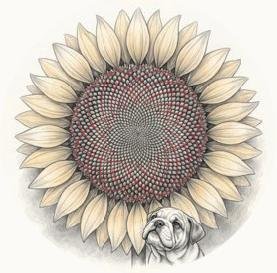
You will see two families of spirals. One family winds one way. The other family winds the other way. They lock together so tightly that not a single seed sits wasted — every space is used, and no two seeds are ever quite lined up.
The flower has no eyes to count them. No mind to plan. It has, somehow, solved a problem that a mathematician has to work hard to solve.
Here is that problem, and its answer, in full.
The problem the flower solved
A growing plant lays down new seeds one at a time. Each new seed is placed a certain angle away from the last one. The plant does this over and over until the whole face is full.
You are the plant. You have a stone in front of you. You must place seed after seed on it, each one turned a fixed angle from the one before, until you have a whole flower’s worth. What angle should you choose?
Try the obvious ones first.
A half-turn (180°). Place a seed, turn halfway around, place another. Turn halfway around, place another. What happens? The second seed lands opposite the first. The third seed lands on top of the first. The fourth lands on top of the second. You end up with only two seeds’ worth of positions, no matter how many seeds you place. Everything piles up.
A third of a turn (120°). Better. But after three seeds you are back where you started, and every seed after that lands right on top of an earlier one. You get three straight spokes with huge empty wedges between them.
Two-fifths of a turn (144°). Every five seeds you return to the start. Five straight spokes. Big empty gaps.
Every “nice” fraction of a circle returns to itself eventually — and the moment it does, all your later seeds start landing on top of your earlier ones. You get a few crowded spokes and wasted space between them.
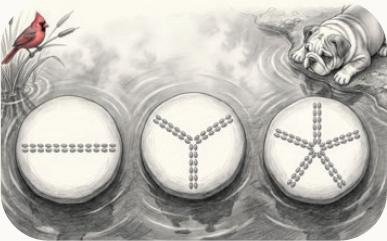
For the flower to fill its face perfectly, it needs an angle that never returns to itself. An angle so awkward, so unmatchable to any simple fraction, that no matter how many times you turn by it, you never land in an old spot.
That angle exists. It comes from one very specific number.
The most irrational number in the world
Before we name the number, we need one word.
You already know whole numbers (1, 2, 3, 4…) and fractions (1/2, 3/4, 5/8…). Any fraction you can write as one whole number over another is called a rational number. That is because a fraction is a ratio of two whole numbers, and “rational” and “ratio” come from the same root.
There are also numbers that cannot be written as a fraction of any two whole numbers, no matter how large. These are called irrational numbers. Their decimal parts go on forever, never repeating. Pi (π ≈ 3.14159…) is one. The square root of 2 is another.
Now here is the beautiful part. Some irrational numbers are almost rational — they can be approximated very closely by simple fractions, so simple fractions “come close” to them. Others are further from any fraction — no simple fraction ever gets very close.
The one number that is hardest of all to approximate with a simple fraction — the number that stays furthest from every fraction, small or large — is a very specific number:
phi (φ) — an irrational number that is approximately 1.6180339887… It is the “most irrational” number in the sense that no simple fraction can ever quite match it.
And here is the part that is worth pausing on. This is not something someone made up. Mathematicians have a precise way of measuring how closely fractions can approximate a number — a ladder of better and better fractions, one on top of the next, called a continued fraction. Every irrational number has one, and the ladder for most irrationals climbs up to the true answer quickly. Phi’s ladder is the slowest possible — every rung is stubbornly small — which is exactly what “hardest to approximate” means, made precise. Phi’s ladder is a tower of the number 1, over and over: 1, then 1 plus 1 over 1, then 1 plus 1 over (1 plus 1 over 1), and so on forever. Slow all the way up.
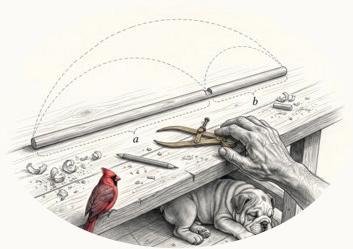
Phi is also called the golden ratio. And it has a beautiful geometric definition, which Giovanni names in the fable: divide a line so that the whole line is to the long part as the long part is to the short part. There is only one cut in the world that does that. That cut is phi.
The golden angle
Take phi. Slice a circle by it: divide 360° so that the two parts are in the ratio phi to one. The smaller slice is the golden angle, and it is exactly 137.5° (well — approximately; like phi, it never quite settles into any simple form).
Turn by this angle, seed after seed, and something remarkable happens.
Every seed lands in a new place. No seed ever falls in line with any earlier seed. There are no spokes. There are no wedges. Every gap fills. The face packs tight.
Not just any irrational angle will do this well. Some irrational numbers are close enough to simple fractions that a plant using their angle would still leave faint lines and small wasted spots. Only the most irrational number — phi — avoids that entirely. That is why the flower uses phi and no other number.
As Baloo says in the fable: “It isn’t magic. It’s only not wasting room.”
That is the whole theorem. The most beautiful pattern in the meadow is not a decoration. It is the answer to the question, “how do I waste nothing?” — carved by a flower that cannot count.
The spirals you see
Look at a real sunflower and count the spirals winding one way. Then count the spirals winding the other way.
You will nearly always get two numbers from this sequence:
1, 1, 2, 3, 5, 8, 13, 21, 34, 55, 89, 144…
This is the Fibonacci sequence, first written down in the 13th century by an Italian mathematician named Leonardo of Pisa (nicknamed Fibonacci). Each number is the sum of the two before it. 1 + 1 = 2. 1 + 2 = 3. 2 + 3 = 5. 3 + 5 = 8. And so on.
A small sunflower might have 34 spirals one way and 55 the other. A larger one, 55 and 89.
Always neighbors in the sequence.
Why? This is not a second coincidence stacked on top of the first. It falls straight out of the same fact.
The fractions built from Fibonacci numbers — 3/5, 5/8, 8/13, 13/21, 21/34, and so on — are the very best simple approximations that exist to phi. So those fractions of a circle are the directions in which two seeds come closest to lining up. Your eye catches those near-lines as spirals.
Same number, seen twice. Phi in how the seeds are placed. Fibonacci in how your eye reads the pattern afterward.
The study of this — how plants arrange their leaves and seeds — is called phyllotaxis. It has been observed for centuries. But you might still ask: is this really physics, or is it just biology?
Here is the answer.
Douady and Couder, 1992
In 1992, two French physicists — Stéphane Douady and Yves Couder — did an experiment that settled the question.
They took a shallow dish of oil. They dripped small magnetized droplets into it, one at a time, from directly above the center. Each new droplet fell into the center and, repelled by the magnetized droplets already there, drifted outward. The angle at which the new droplet came to rest relative to the old ones was not set by anyone. It was chosen only by physics — by the balance of forces.
The pattern that emerged was the golden angle.
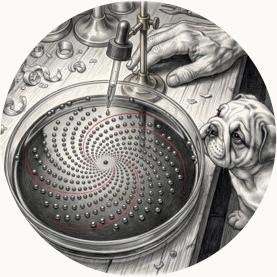
No life. No genes. No plant. No sunlight. Just droplets, oil, and magnets — and the sunflower’s pattern appeared anyway.
That is what settles it. Phyllotaxis is not something plants chose to do. It is simply what any system doing efficient growth arrives at, whether it is alive or not.
One honest word before the wonder
You may have heard that the golden ratio hides in a great many places. In the Parthenon. In the human face. In the price of gold. In the stock market.
Most of that is not true.
Almost all of the famous “golden ratio in art and architecture” claims are what mathematicians call wishful measurement — someone found some ratio in a building close to 1.618, and called it phi even though the numbers weren’t very close, and the ratio wasn’t very well-defined in the first place. The Parthenon does not really have phi hiding in it. Human faces do not really have phi hiding in them. And phi does not predict the stock market.
We say this because a first physics book has to tell you which claims are real and which are mythology. Otherwise you will not know whom to trust later.
But phyllotaxis is real. Sunflowers really do use the golden angle. Pinecones really do count in Fibonacci. This has been measured, tested, and reproduced with magnetized droplets. It is exactly as strange as it sounds.
The wonder left standing
And that leaves us with the true mystery, standing taller than any myth.
A number — a bloodless, abstract thing that lives in no place and weighs nothing — turns out to be written into a flower you can hold in your hand.
The seed does not know what phi is. It simply grows.
And phi is already waiting for it.
Sit with that long enough and you arrive, without meaning to, at the one question this whole book has been walking toward — and the coda is where we finally ask it out loud.
Turn the page. We are almost home.