Baloo & the Pond › Part Four — The Number That Draws
on the one turn the seed and the galaxy share
Prologue
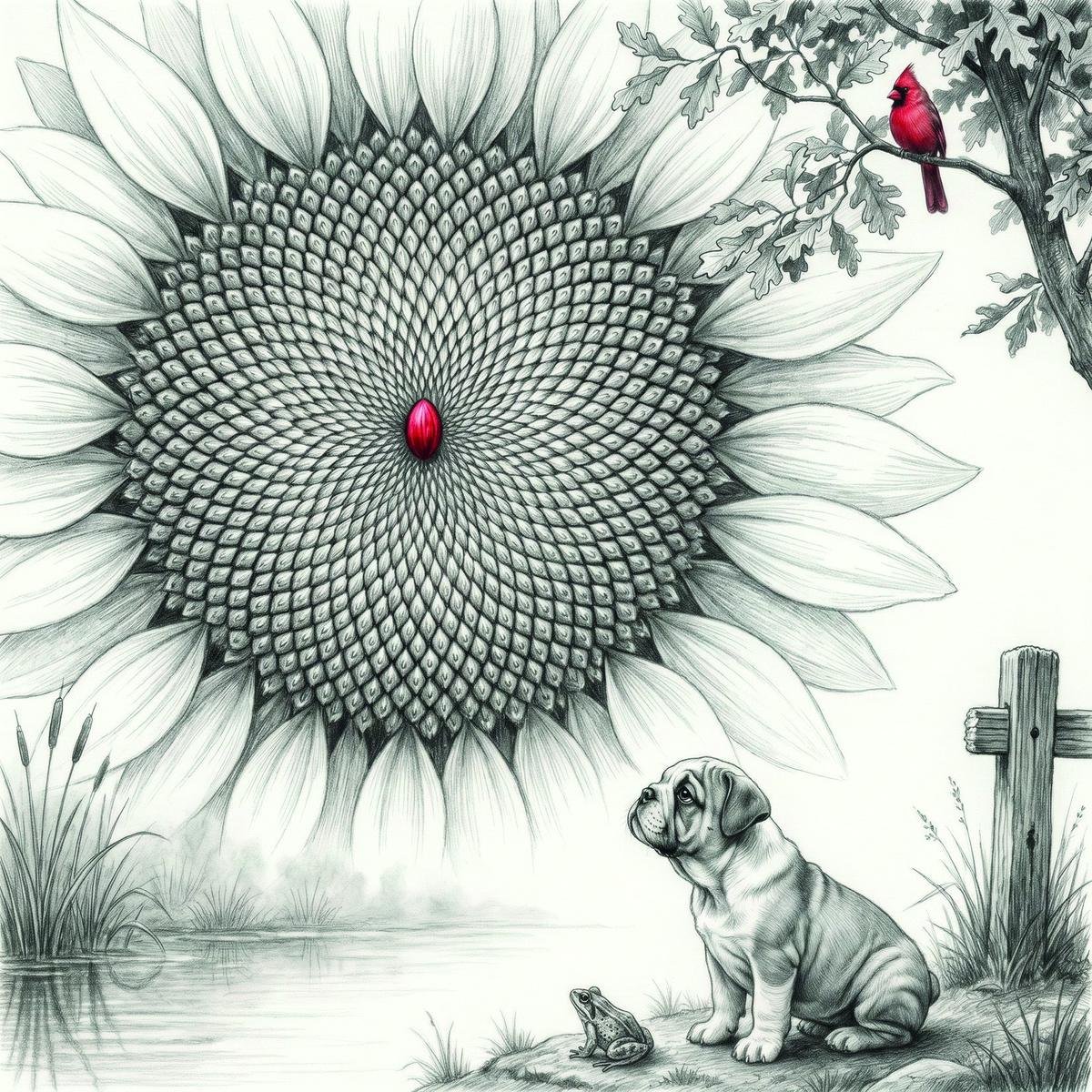
By the end of summer, a sunflower had grown tall beside the pond.
Its face was full of seeds — more than a puppy could count — and it turned all day to follow the light.
It looks like an accident of growing. It is not. There is one small rule hiding in that face, and the rule made all of it.

I
Baloo pressed his nose to the sunflower’s face.
“Frog. The seeds go in curves. Curves this way, and curves that way, both at once.” He was very still now. “And I don’t think it’s an accident.”
“I have sat beside this flower all summer,” said Frog, “and seen only a pretty face. Show me what you see.”

II
“Watch,” said Baloo.
It was the puppy saying watch now, to the old one.
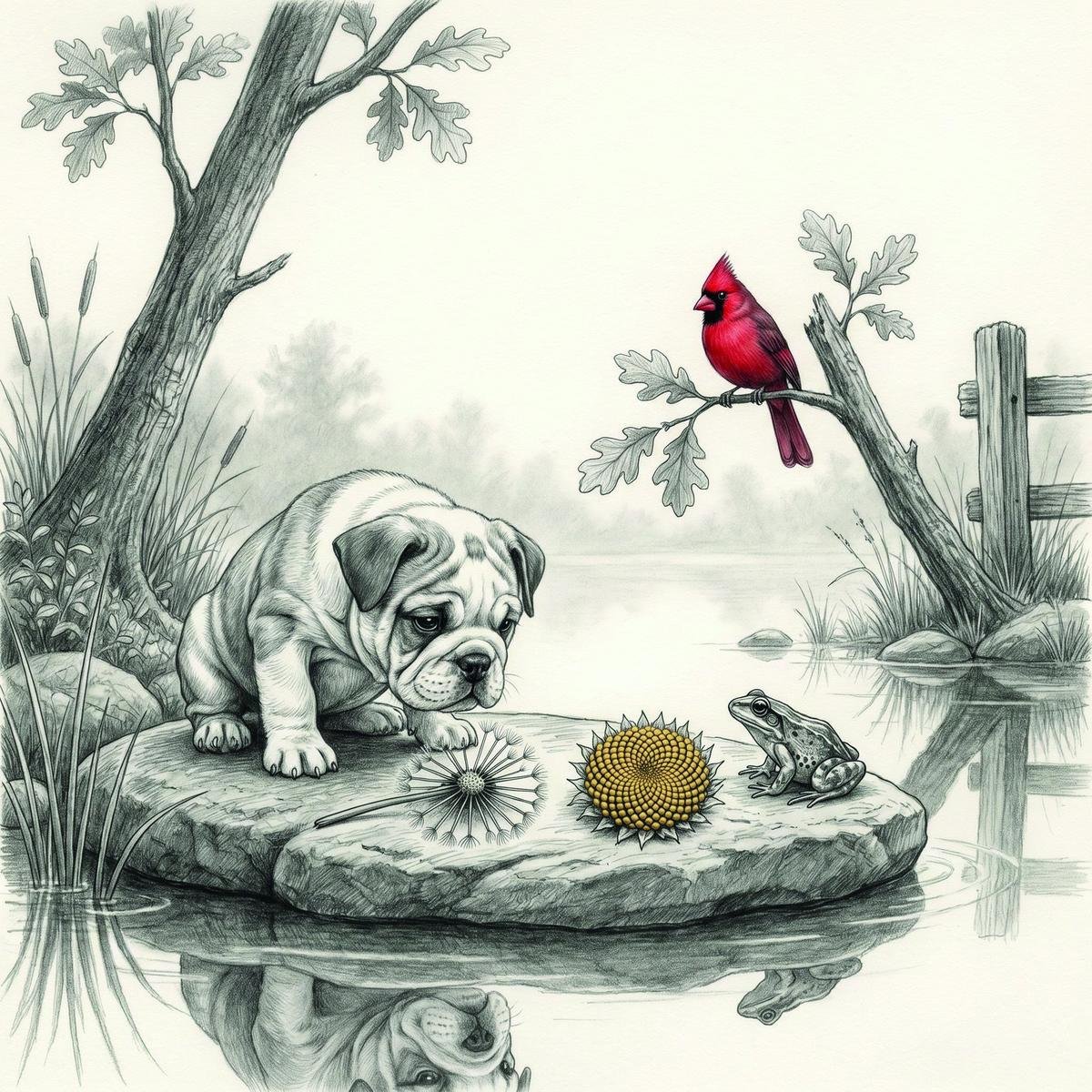
He set a seed on the stone. Then another, a small turn from the first. Then another — the same small turn. Always the same. Never a different one.
And a spiral began to open on the stone, all on its own.
“You did not draw the spiral,” said Frog, leaning close.
“No. I only made one turn. Again and again.” Baloo looked at it, almost shy. “The spiral drew itself. That’s the number that draws.”

III
“But why that turn?” said Frog. “Why not a bigger one, or a smaller one? Here I cannot follow you.”
So Baloo showed him.
He made a flower with a plain, easy turn — a half-turn, round and round. The seeds fell into a few straight spokes, with wide empty gaps between them — wasteful and thin.
“See? A plain turn comes back to where it started. So the seeds land on top of each other, in a few lines, and leave all that room empty.”
Then he made the special turn instead. And the seeds packed close, and full — every space used, none wasted, no two ever quite lining up.
“This one never comes all the way back. It never repeats. So it never leaves a gap. It fits the most into the least.” He looked up. “It isn’t magic, Frog. It’s only not wasting room.”
IV
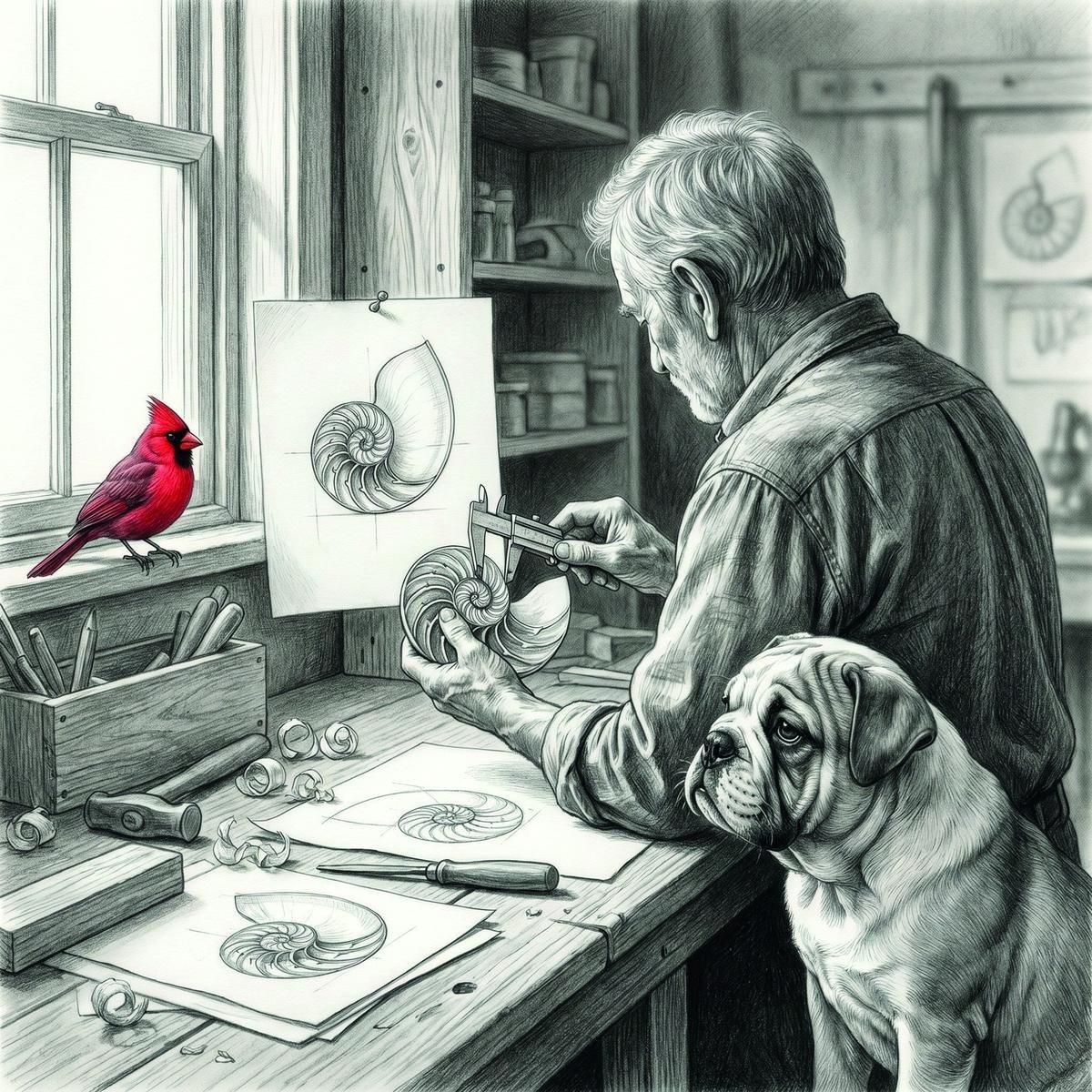
The old man had a shell on his bench, and he was measuring it.
He measured the shell. And a curl of fern. And the seeds Baloo had left on the stone. And each time, the same small nod.
“He keeps finding my number,” said Baloo. “In the shell, and the fern, and the flower.” He tilted his head. “Not because someone painted it there. Because each of them had the same problem — how to grow, and not run out of room.”
“You are teaching me and him,” said Frog, “in the one morning.”
V
Baloo gave Frog a pinecone.
“Two families of curves again. Like the flower. Count them one way, then the other — and you get two numbers.” He paused. “And the second is made of the first. Each new number is the two before it, added together.”
Frog turned the pinecone slowly in his webbed hands.
“The simplest counting a child could do,” he said, wondering. “And I never once counted.”
“The flower knows this counting. So does the shell. So does the way leaves climb a stem — so no leaf sits in another’s shade.”

VI
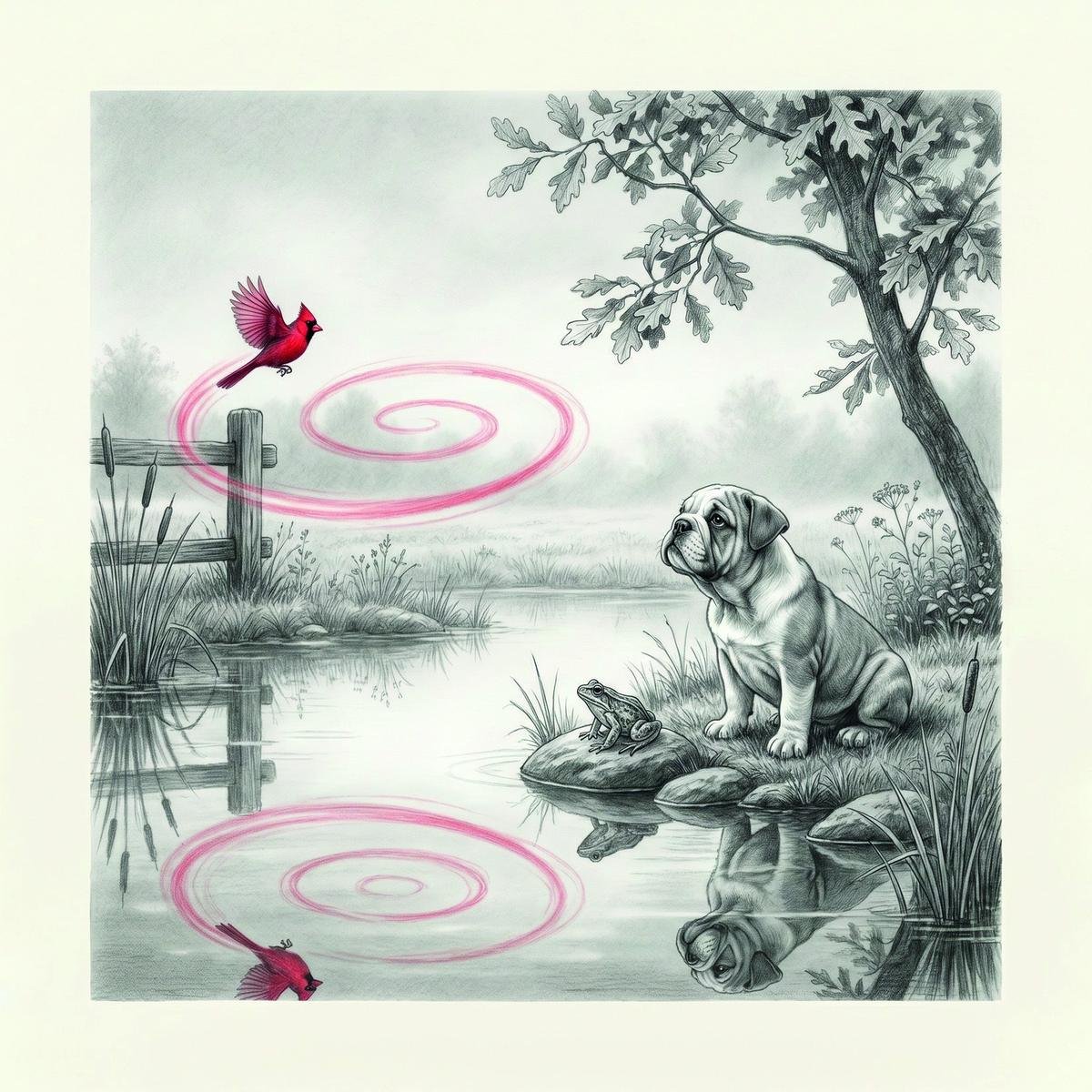
The cardinal lifted off the sunflower and did not fly straight.
It turned as it climbed, a widening curl, kin to the seeds and the shell.
The still pond held the whole spiral of its flight.
“Even the bird,” said Baloo, quiet now. “A hawk falls in a curl like it. A galaxy turns in one. The very large and the very small, curling the same way.”
“Now that I can add to,” said Frog. “You found the rule. Here is the old one’s part. The same curl in the seed and the sky is not the universe showing off. It is the world being sparing. At every size, the cheapest way to make a curve is to turn a little, and grow a little, and do it again.”
VII
For once it was Frog who tried the thing, and Baloo who taught.
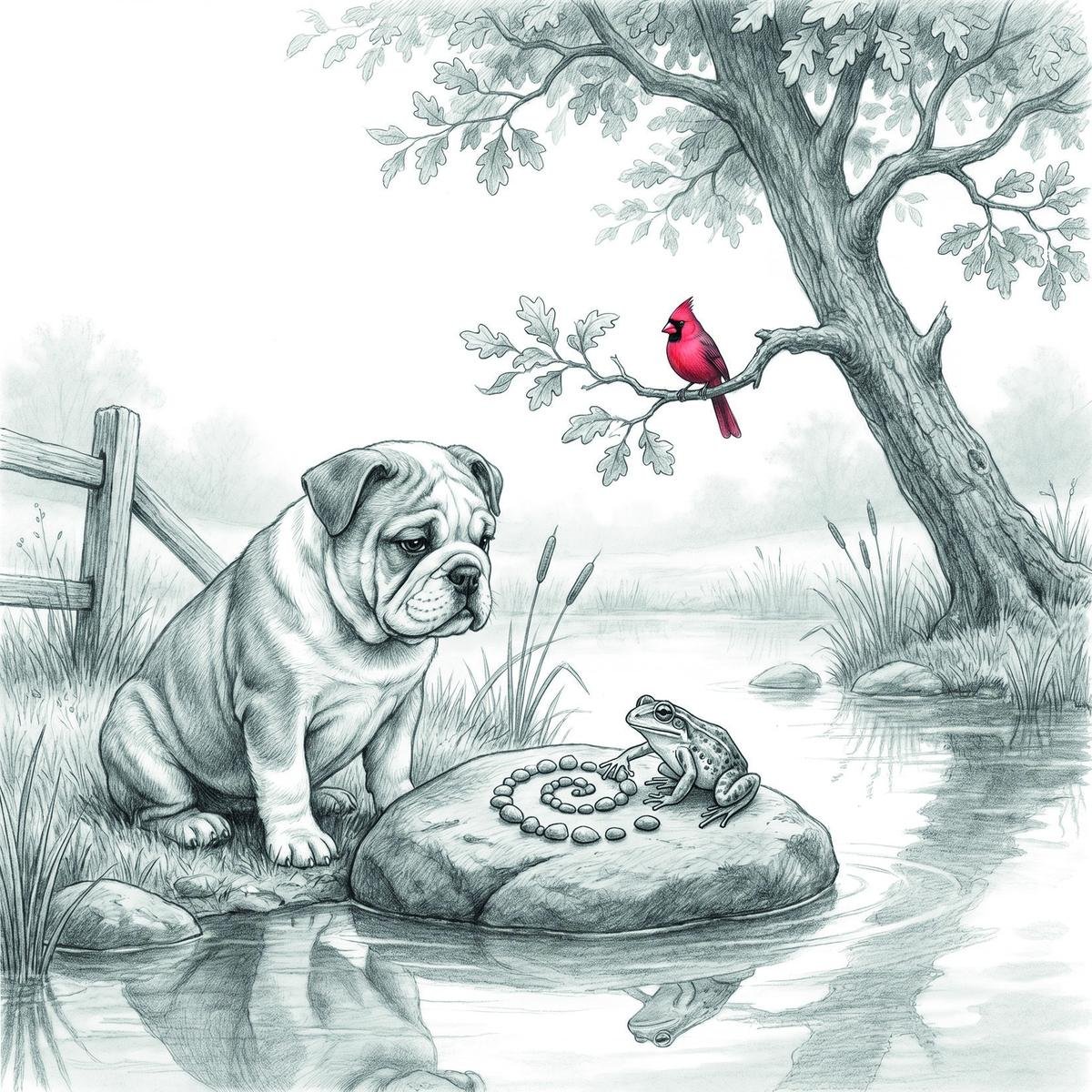
Frog placed the pebbles. His first turns were too big — he made a clumsy star. Then too small — a tight, useless knot.
“Not too much,” said Baloo. “Not too little. The same turn, every time.”
And Frog found it. A small spiral opened under the old one’s careful hands. “I made the number draw,” said Frog. And something in the old face was young.
“You made one turn well,” said Baloo, “and did it again. That is all anyone does.”
VIII
At dusk the sunflower bowed a little, heavy with all its seeds.
Every seed had a place. Not one space wasted. The whole heavy face of it, built from one turn made a thousand times — and the flower never once knowing it was building anything.
Baloo looked up at it. He had found the rule. But he was quiet, and did not know why.
“You are learning the last part now,” said Frog. “The part that is mine. It did not know it was beautiful. It was only trying not to waste room.”
And became beautiful by accident, the way the truest things do.

IX
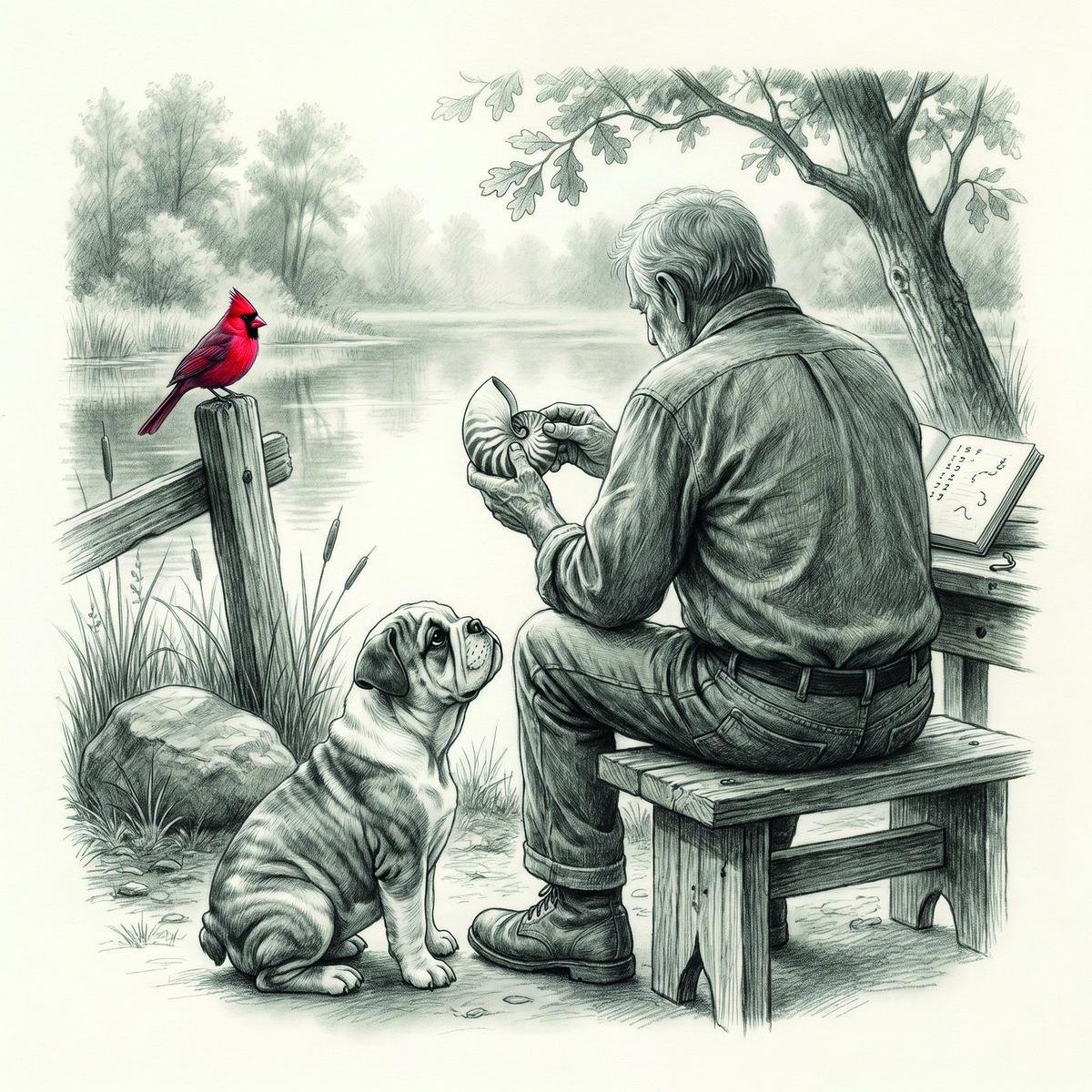
The old man turned the shell over in his fingers for a long time. He did not know Baloo was listening, or he did not mind.
“Divide a line,” he said, to the shell more than to Baloo, “so the whole is to the long part… as the long part is to the short.” He held the shell up against the light. “One cut. There’s only one cut in all the world that does it.”
“Sixty years,” he said, lower still. “I’ve measured these. Shell, and seed, and horn, and the far white arm of a galaxy through a glass.” He turned it again. “The same turn. The same number. Every time.”
A long pause. The pond held still.
“I still don’t know why the world troubled itself to be this beautiful.” He set the shell down among his papers. “I don’t suppose I’ll get it now.”
And then — not sad. Something lit in the old voice, something the puppy at his boot would remember his whole life.
“But I got to notice. Sixty years of noticing.” He almost laughed. “That was the whole prize. That was the whole of it.”
X
Baloo looked into the full face of the sunflower one last time.
The curves went this way, and that way, and every seed had found its place — by following one small turn, over and over, since the beginning.
“One turn,” said Baloo. “Made again and again.”
“One turn,” said Frog. “Made again and again. You found it. I only taught you to be still. And now you see beyond what I can see.”
Frog looked at Baloo.
“You’ve gone on past me,” he said. Not sadly. “That is the one thing a teacher hopes for, and cannot make happen.”
He settled on the stone, and was glad.
“That is how it should go.”
That night the old man’s lamp was still burning in the workshop, long after the pond had gone dark. Baloo saw it from the grass. He did not go up yet. But he knew he would. The seed, the shell, and the galaxy are not copying each other. They are each, separately, discovering the same cheapest way to grow. It is the fingerprint the universe leaves whenever it makes more of something without starting over.