Baloo & the Pond › The Physics Behind Part Three
So you want to know about the room we cannot point to.
Start with an easier room. A room you can point to — but that you have to imagine yourself out of first.
The flat creature
Before we go further, one word. When physicists say dimension, they mean an independent direction you can move in. You can walk forward-and-back — that is one dimension. You can walk left-and-right — that is a second. You can climb up-and-down — that is a third. Three dimensions is how many independent directions our world gives us.
Now imagine a small creature — a bug, if you like — who lives on the surface of the pond. Not in the water. On the skin of it. Everywhere the bug walks, it walks flat. Forward. Sideways. It has no idea that “up” exists. For this bug, up is not far away. Up is unimaginable — a word with nothing behind it.
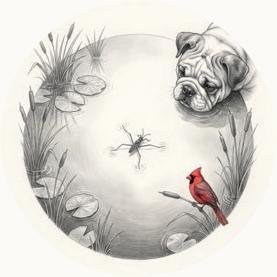
This creature comes from a book called Flatland, written in 1884 by an Englishman named Edwin Abbott. He invented the flat world so that we — three-dimensional creatures — could imagine what it might be like to be trapped inside fewer dimensions than there really are. The lesson turns out to be one of the deepest in modern physics.
Push your finger through the water
Now watch what happens when a three-dimensional thing enters the flat creature’s world.
You reach down and slowly push one finger down through the surface of the pond.
The bug, looking around, has never seen a finger. It only sees the flat part where your finger meets the water. What does it see?
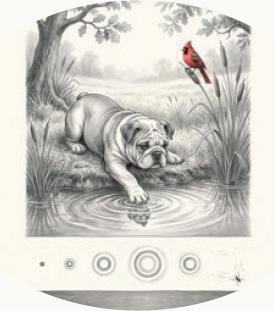
First, a dot appears from nowhere. Then the dot swells into a small ring. The ring grows larger. Then, as the finger widens and narrows through the joints, the ring shrinks. Then it vanishes.
To the flat bug, an object appeared, changed shape mysteriously, and disappeared.
To you, standing above the water, nothing mysterious happened at all. Your finger was whole the whole time. The bug simply met it one slice at a time.
That is the whole idea. Baloo says it perfectly in the fable: “Nothing is missing. He just hasn’t reached the rest of me.”
A slice is not a broken thing. It is a whole thing you have not yet reached the rest of.
The turn that should stop you
Here is where the lesson turns on us.
We are the flat creatures.
Not because we lack cleverness. Because our eyes, our brains, and our imaginations were built inside three dimensions — the way the bug’s were built inside two. We can walk forward, sideways, and up-and-down. Three directions. And that is the shape of the world we can picture.
But there is very likely a fourth direction — a real one, not a fantasy — that we cannot point to, because we do not have the mental equipment to imagine it, any more than the flat bug can imagine “up.”
We cannot picture it. But — like Giovanni in his workshop — we can build its shadow.
The tesseract
Watch what a shadow does. Take a cube — a three-dimensional block. Shine a light on it. What lands on the wall is a flat, two-dimensional shape: a square, or a hexagon, depending on the angle. That flat shape is real. You can trace it. But it is not the cube. It is what a cube looks like when it is caught in a world with one less dimension than it really has.
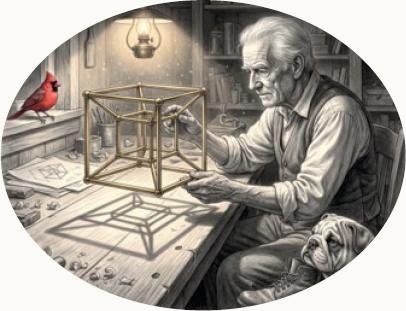
Now go up one level. A four-dimensional cube would throw a three-dimensional shadow. That shadow is a real shape. Physicists and mathematicians have a name for it: the tesseract. It looks like a cube inside a cube, with lines connecting the corresponding corners. You may have seen it drawn. It is a real object — as real as a hexagonal shadow on paper is real. It is the closest we can come to seeing a four-dimensional thing without being one.
Giovanni holds the tesseract in the fable. He knows he cannot build the whole four-dimensional cube — no one can, here. But he can build its shadow, and keep it near him. That is the whole art.
Time is a direction
Now for the strangest claim in this book.
The fourth direction is not out past the sky. It is not somewhere far away. It is not exotic.
You are standing in it. You call it time.
In 1905, Albert Einstein published his theory of relativity. Three years later, a mathematician named Hermann Minkowski looked at Einstein’s equations and gave a famous lecture at Cologne, in which he said: from now on, space by itself and time by itself will fade away, and only a union of the two — spacetime — will remain. Time, he showed, is not something happening to space. It is another direction, joined to the three we already know.
And here is what that means.
The whole life of that oak by the pond — every season it will ever wear, from acorn to sapling to tall tree to bare branches to the day it finally falls — all of it exists together, as one long four-dimensional shape. Like your finger passing through the water, the whole tree is already whole.
You do not walk past the oak. You walk through it — one slice at a time. And you call each slice now.
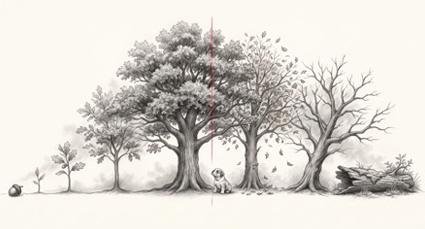
This picture is called the block universe. On this view, past, present, and future all exist together, standing lit and whole. The feeling of time flowing — of moments arriving and then being gone — would then be nothing more than the feeling of a creature moving through itself, one slice at a time.
If this picture is right, then the moment you were born and the moment you will die are both already there, no less real than this one. Nothing is coming. Nothing is going. The oak in autumn is not lost. It is only in a part of the shape you have not yet reached.
That is a very large if. We will come back to it in a moment.
The last honest door
Whether time truly flows — whether the future is being made moment by moment — or whether we only travel a landscape of moments that were always there, is one of the last open doors in all of physics. Very good physicists disagree about it. Einstein leaned one way; others lean the other.
The honest answer to what lies past that door is that no one has walked through.
But you have already learned the shape of the question. And knowing you cannot yet answer it — knowing exactly which parts are settled and which parts are open — is the whole art. That is how physics is done.
Turn the page, and we will look at a flower.