Baloo & the Pond › The Physics Behind Part Two
So you want to know what the coin is.
Spin a coin on a table. While it spins, ask any physicist which face is up.
The honest answer is not, “I can’t see yet.”
The honest answer is: there is no face yet.
This is the strangest fact in this book, and everything else in this section turns on getting it right.
The dragonfly and the coin
Before we go further, we have to tell two things apart that most people confuse.
Watch a dragonfly’s wing. It moves so fast that your eye can’t catch it, and you see only a blur. If you could freeze it — take a photograph fast enough — you would see one wing in one definite place. It was always in one place. Your eye just wasn’t quick enough.
That is called hidden information. There is a real answer, and it is being kept from you by speed.
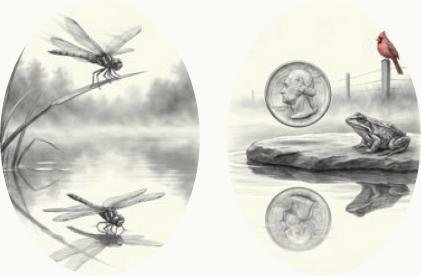
Now spin a very small coin — the kind made of a single electron, or a single particle of light called a photon. Freeze it mid-spin. Take the picture as fast as you like.
You will not find one face. You will find both faces at once. Not as a blur. As a real blend. A genuine two-in-one.
Physicists have a name for this:
superposition — a real blend of two possibilities, both true at the same time. Not hiding. Not too quick to see. Really both.
The dragonfly is quick. The quantum coin has not chosen. Those are not the same thing.
The wave function
To describe a thing in superposition, physicists use a mathematical object called the wave function, usually written with the Greek letter ψ (“psi,” pronounced “sigh”).
You do not need to solve it. You only need to know what it is: a way of writing down every possibility a small thing is holding open at once. Two faces of a coin. Two paths through a slit. Two places to be. The wave function keeps all of them alive together until something makes the coin land.
Who makes the coin land?
In the fable, Baloo puts his paw down on the spinning coin. It stops. One face, sharp and certain, under his pad.
That moment has a name too:
measurement — when the world reaches in and forces a superposition to become just one thing.
The critical word is world.
Most people think it takes a person, or an eye, or a mind. That is a misreading. When physicists say “an observer makes the wave function collapse,” they don’t mean “a human watches.” They mean anything at all touches it. A raindrop landing on the coin will do it. A leaf drifting past. A puff of air. A single photon of light bouncing off it.
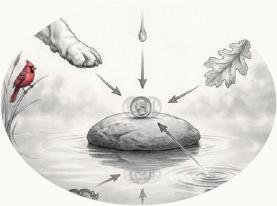
This is why “consciousness collapses the wave function” is a popular but wrong idea. The world is touching itself all day long. Consciousness is one small kind of touching among a trillion others.
The proof: interference
You might reasonably ask: how do we know the coin was really in superposition, and not just hiding its answer very cleverly?
The proof is an experiment called the double-slit experiment, and it is the single most important demonstration in all of quantum physics. Richard Feynman, one of the greatest physicists of the last century, said this experiment contains “the only mystery.”
Here is how it works.
You have a wall with two narrow slits cut in it. Behind the wall is a screen — something that records where particles land, like a photographic plate. You fire particles at the wall one at a time. An electron. Then another. Then another. Each one has to get through one of the two slits to hit the screen.
Now — what would you expect?
If each electron is a tiny ball, it goes through one slit or the other. Over time, you should see two bright stripes on the screen, right behind the two slits.
That is not what happens.
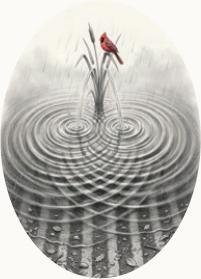
What you actually see, after hours of firing electrons one at a time, is a pattern of many alternating bright and dark bands. Physicists call this an interference pattern, because it looks exactly like what happens when two waves cross each other in a pond — where two ripples meet, the water climbs high; where they cancel, it goes flat.
In the fable, Baloo sees this in the rain, when the drops make rings on the water. He is the first to say it: “Where two of them meet they climb tall, or they cancel flat. The coin, the birds, the paths — they aren’t little balls waiting somewhere. They’re spread out, like water.”
That is exactly right. A particle in superposition is not a small ball with a hidden answer. It is spread out, like a wave, going through both slits at once and interfering with itself on the far side. Only a thing that was truly in two places can make the striped pattern appear. The dragonfly cannot do this. A tiny ball cannot do this. Only superposition can.
The strangest fact of all: entanglement
Now for the part that made Einstein lose sleep.
You can take two coins and prepare them together, in a special way, so that they become entangled — linked as a single object, even though they are two separate pieces.
You send one coin to the North Pole and the other to the South Pole. Neither one has decided which face is up. Both are in perfect superposition.
Now you look at the North Pole coin. It lands on heads.
In that instant — the very same instant, with no delay — the South Pole coin becomes tails.
Guaranteed. Every time.
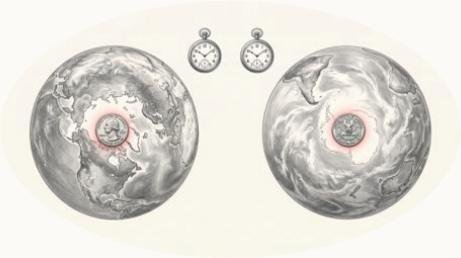
Nothing traveled between them. No message. No signal. If a signal had traveled, it would have had to go faster than light, which nothing can do.
Einstein hated this so much that he called it “spooky action at a distance” and spent the last thirty years of his life trying to prove it wasn’t real. He believed the coins must have been secretly heads and tails all along, and we just didn’t know until we looked.
In 1964, an Irish physicist named John Bell figured out how to actually test that hope. He wrote down a limit — now called Bell’s inequality — that any “secret answer” theory must obey. If Einstein was right, entangled coins could never break the limit.
Every experiment since has broken it.
The answers were not fixed in secret. The two coins really are one thing, across any distance. The universe really is this strange.
One honest note
Notice the difference between this and the mystery at the end of Part One.
The “why is there a now” question is genuinely open — no one knows the answer.
Entanglement is not open. It is settled, proven a thousand times over. We are simply left holding a fact we can measure to perfection and still cannot make feel true.
That may be the most honest place physics ever puts you: a thing you can prove is real, and still cannot believe.
Turn the page, and we will find a room we cannot point to.